
By FRANCE 24 with AFP and published by Yahoo!News
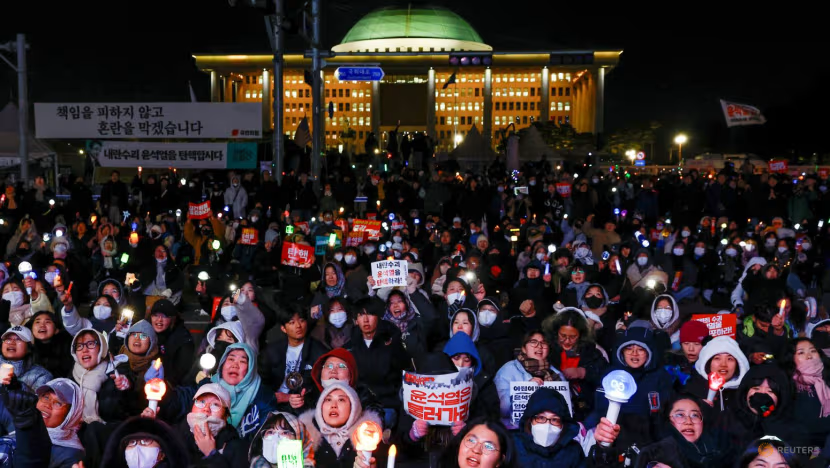
Seoul – South Korean President Yoon Suk Yeol survived an impeachment motion on Saturday (Dec. 7) for imposing martial law after his party’s lawmakers boycotted the vote, despite mass protests outside parliament calling for his ouster.
Yoon stunned the nation and the international community on Tuesday night by suspending civilian rule, but was forced into a U-turn after lawmakers nixed his decree.
Opposition parties, which hold 192 seats in the 300-seat parliament, filed the impeachment motion which needed 200 votes to pass.
But all but one member of Yoon’s People Power Party (PPP) on Saturday filed out of the chamber before the vote, live TV footage showed, meaning that the motion lacked the necessary quorum.
“With a total of 195 votes, the number of members who voted did not reach the required two-thirds majority of the total members. Therefore, I declare that the vote on this matter is not valid,” National Assembly speaker Woo Won-shik said.
The outcome is likely to enrage the nearly 150,000 people demonstrating outside parliament calling for Yoon’s ouster, according to news agency Yonhap.
Apology

Before the vote, Yoon, 63, spoke for the first time in three days and apologised for the turmoil but stopped short of stepping down, saying he would leave it to his party to decide his fate.
“I caused anxiety and inconvenience to the public. I sincerely apologise,” he said in the televised address.
He said he would “entrust the party with measures to stabilise the political situation, including my term in office”.
His PPP stuck to the official line that they would block impeachment, even after party head Han Dong-hoon said Yoon must go to avert more political chaos.
“The normal performance of the president’s duties is impossible under the (current) circumstances, and an early resignation of the president is inevitable,” Han told reporters Saturday.
Enough votes?

If the motion had passed, Yoon would have been suspended from duties pending a ruling by the Constitutional Court.
Opposition leader Lee Jae-myung said Yoon’s comments on Saturday were “very disappointing” given the widespread anger among South Koreans.
His speech “only exacerbates the sense of betrayal and anger among the citizens”, Lee said, adding the only solution was “the immediate resignation of the president or an early departure through impeachment”.
An opinion poll released on Friday put backing for the 63-year-old president at a record low of 13 percent.
“The public will not forgive him,” 63-year-old retiree Lee Wan-pyo told AFP at Seoul’s main train station before the vote.
“I just want him to step down,” said Han Jeong-hwa, a 70-year-old housewife.
Detain the politicians?
Regardless of the vote, police have begun investigating Yoon and others for alleged insurrection.
In his address declaring martial law late Tuesday, Yoon claimed it would “eliminate anti-state elements plundering people’s freedom and happiness”.
Security forces sealed the National Assembly, helicopters landed on the roof, and almost 300 soldiers tried to lock down the building.
But as parliamentary staffers blocked the soldiers with sofas and fire extinguishers, enough MPs got inside — many climbed walls to enter — and voted down Yoon’s move.
Soldiers had been ordered to detain key politicians, lawmakers from both parties have said, with the special forces chief later describing being given orders to “drag out” MPs from parliament.
Experts and lawmakers have speculated that the elite special forces soldiers may have slow-walked following orders, after discovering themselves to be involved in a political rather than national security incident.
The episode brought back painful memories of South Korea’s autocratic past and blindsided its allies, with the US administration only finding out via television.
US Secretary of State Antony Blinken told his Korean counterpart Cho Tae-yul on Friday that he “expects the… democratic process to prevail”.
CAPTIONS:
Top: Protesters react after South Korean President Yoon Suk Yeol, who declared martial law which was reversed hours later, survived an impeachment motion, in front of the National Assembly in Seoul, South Korea, today, Dec. 7, 2024. Photo: Reuters/Kim Kyung-hoon and published by CNA
First insert: A protester reacts after South Korean President Yoon Suk Yeol survives an impeachment motion, in front of the National Assembly in Seoul, South Korea, today, Dec. 7, 2024. Photo: Reuters/Kim Kyung-hoon and published by CNA
Second insert: South Korea’s main opposition Democratic Party lawmakers hold placards reading “impeach Yoon Suk Yeol”. Photo: AFP/Jung Yeon-je and published by CNA
Front Page: A South Korea flag flutters in the wind as a general view shows people taking part in a protest calling for the ouster of South Korea President Yoon Suk Yeol outside the National Assembly in Seoul today, Dec. 7, 2024. Photo: AFP/Yonhap and published by CNA
Also read: South Korean President Yoon abandons martial law attempt
Four Thai fishermen’s freedom from Myanmar only a matter of time
Pheu Thai to push for anti-coup legislation
Hunt for Moroccan man wanted in murder of his ex-gay partner in Chiang Mai
No hope for global peace as ‘merchants of death’, mostly American, rake in billions
